


If you've been following tech news lately, you've probably seen something about the federal government banning routers. It sounds like the kind of headline that doesn't actually affect you. This one kind of does, especially if you're a homeowner in Aspen, Snowmass, Basalt, Carbondale, Glenwood Springs, or anywhere else in Eagle, Garfield, or Pitkin County where your internet setup is already fighting terrain, weather, and peak season all at once.
Already use a Pathfinder router? Skip to the bottom. You're covered. For everyone else, read on.
The federal government just flagged your router as a national security risk
On March 23, 2026, the FCC updated what it calls its Covered List, which is essentially the government's catalog of communications equipment deemed too risky to allow into the country. This time, they added all new consumer-grade routers produced in foreign countries, and the reasoning is more specific than the usual regulatory language.

A White House-convened national security body determined that foreign-produced routers present two documented threats.
1
The first is supply chain vulnerability, meaning the hardware itself can be compromised during manufacturing before it ever reaches your home.
The second is the one that gets people's attention: the government concluded that hostile foreign governments may have already embedded persistent backdoor access into router firmware, giving them the ability to monitor your network traffic, your connected devices, and your household communications without you ever knowing it was happening.
The federal government cited the Volt, Flax, and Salt Typhoon cyberattack campaigns, all attributed to Chinese state-sponsored actors, as real cases of this kind of exploitation targeting American homes and infrastructure. This is not hypothetical. It already happened, which is why the FCC acted.
What the ban actually does and doesn't do
The headlines made this sound like the government was about to show up and confiscate your router. That's not what's happening. If your router already has FCC authorization, which any router currently installed in your home does, it is completely unaffected by this ruling. The FCC was clear on this in its official fact sheet: the ban applies only to new router models seeking authorization after March 23, 2026.
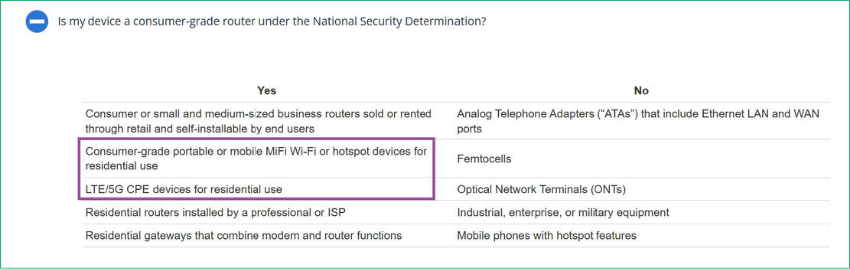
That scope is also broader than most people assume. In the FCC’s latest guidance (as of 4/21/26), “consumer-grade router” can include more than the box you plug into your wall. It can also cover certain portable/mobile MiFi hotspot devices, LTE/5G CPE devices used in residences, and gateway devices that combine modem and router functions—even if the router was installed by an ISP or a professional.
None of that means you need to rip out what you have today. But it does raise a long-haul question that applies to routers and hotspot-style devices alike: if the federal government has formally classified this category of gear as a serious cybersecurity risk, is it what you want sitting at the center of your network long-term? And if manufacturers are blocked from bringing in new products under that framework, what happens to the incentive to keep security updates and support moving for older devices? Security updates don’t happen out of goodwill. They happen because companies have customers to retain and regulators to answer to. When that calculus changes, your security posture can change with it.
What this means for homeowners in the Roaring Fork Valley specifically

Mountain communities like ours have a few things working against us when it comes to home network security. Seasonal occupancy means homes sit unmonitored for weeks at a time. Second homes and vacation rentals cycle through guests and devices constantly. Smart home systems, security cameras, and automation equipment all run through that one router, and most people have no idea who manufactured it or whether it's receiving regular security updates.
- If you want a deeper look at why home network security deserves more attention than it usually gets in mountain communities, we covered that ground here.
And per the FCC’s latest guidance, this isn’t only about the “router” you picture sitting on a shelf. The same consumer-grade category can also include certain portable MiFi hotspot devices, LTE/5G home internet gateway-style devices, and combo modem/router gateways. In other words, some of the exact “Plan B” devices people use for second homes and rentals can fall under the same umbrella.
So here are the questions that actually matter. If your provider shipped you the equipment, do you know what it is, who made it, and whether it falls under the FCC’s covered equipment definition? More importantly: does your provider know?
These aren’t trick questions. A homeowner in Aspen, Carbondale, or Edwards should be able to get a straight answer from whoever is providing their internet service. If you can’t, that’s useful information.
Already using a Pathfinder router? You're covered. Literally.
Every Pathfinder service plan includes a router at no extra charge, and we vet the equipment before it ever shows up at your door.
You don't have to research the FCC Covered List, cross-reference country of origin, or wonder whether whatever's on sale this weekend is a liability. We handle that part because that's what a local provider who actually knows this valley should be doing.
We're not a national operation running you through a call center script. We're based in Glenwood Springs, we serve communities from Aspen and Snowmass down through Basalt, Carbondale, and the broader Roaring Fork Valley into Eagle County, and we know what it means when a second home needs to just work the moment you arrive in December. Part of that reliability is knowing exactly what hardware is on your network and making sure it stays current. That's always been part of the deal here, not because the FCC told us to, but because it's the right way to run a local internet service. You can read more about what sets us apart from the big providers here.
You don't have to research the FCC Covered List, cross-reference country of origin, or wonder whether whatever's on sale this weekend is a liability. We handle that part because that's what a local provider who actually knows this valley should be doing.
We're not a national operation running you through a call center script. We're based in Glenwood Springs, we serve communities from Aspen and Snowmass down through Basalt, Carbondale, and the broader Roaring Fork Valley into Eagle County, and we know what it means when a second home needs to just work the moment you arrive in December. Part of that reliability is knowing exactly what hardware is on your network and making sure it stays current. That's always been part of the deal here, not because the FCC told us to, but because it's the right way to run a local internet service. You can read more about what sets us apart from the big providers here.